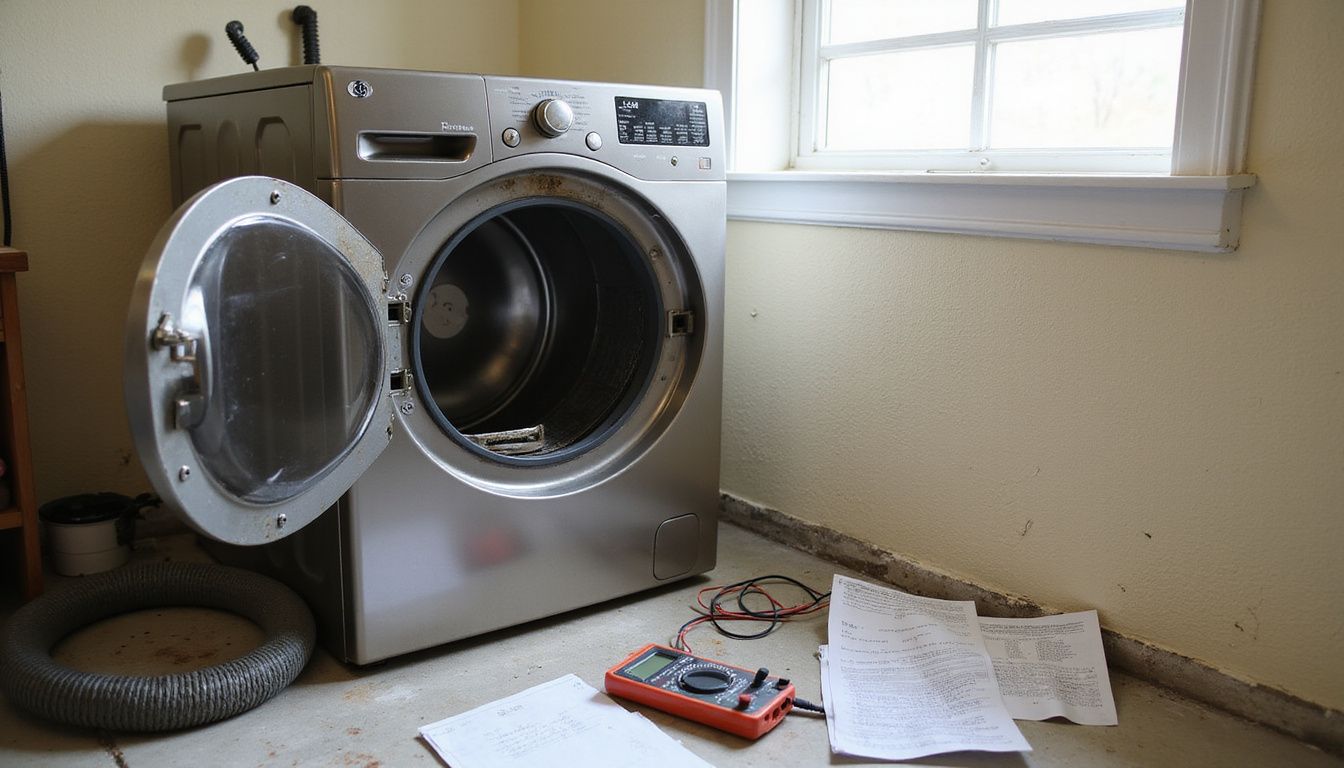
GE dryer repair usually gets easier once you stop guessing and start with the three checks that matter most: power, airflow, and safety parts.
In my 25 years repairing appliances in Staten Island, I have found that most dryers that will not heat or will not start are not suffering from a mystery failure. They usually have a tripped breaker, a blocked vent, a bad door or start switch, or a blown thermal fuse.
This guide gives you the exact troubleshooting order, simple repair solutions, and the point where it is smarter to call a certified GE dryer repair technician.
Keep your model number nearby before you start. GE Appliances says the tag is usually just inside the dryer opening, and newer tags may include a QR code that pulls up model-specific support.
Key Points
- Check power first: most electric GE dryers need two live 120-volt legs for heat, so the drum can still spin even when one breaker has tripped.
- Airflow matters as much as the heater itself. A dirty lint screen, kinked vent, or blocked outside hood can cause long dry times, no heat complaints, and repeat thermal fuse failures.
- Start problems usually trace back to the door switch, push-to-start switch, thermal fuse, or a control panel that needs a simple reset.
- Noise gives useful clues: squeals point to the idler pulley or drum rollers, while scraping often means worn glides or a foreign object caught near the drum.
- Professional service makes the most sense for gas issues, repeated breaker trips, control board faults, motor replacement, or any repair that still fails after basic meter tests.
What Are Common Problems with GE Dryers?
Most GE dryer complaints fall into four buckets: no heat, no start, mid-cycle shutdown, and noise. Once you match the symptom, you can usually narrow the fault to just a few parts.
- Runs but does not heat: check breakers, voltage, venting, the heating circuit, and gas supply if you have a gas model.
- Will not start: check the door switch, start switch, thermal fuse, and settings.
- Stops before the load is dry: look for overheating, blocked exhaust, sensor issues, or a weak motor.
- Makes loud noise: inspect the belt path, idler pulley, rollers, glides, and blower area.
Start with these basic troubleshooting steps so you do not replace a good part by mistake.
Watch a quick GE dryer troubleshooting video
Why Is My GE Dryer Not Heating?
No heat usually comes from one of three causes: bad airflow, missing voltage, or a failed heating component. That is the order I would check them in.
For electric models, confirm full power before you open the cabinet. Many GE manuals note that most electric dryers use two breakers, and the dryer may tumble but not heat when only one side of the circuit is live. GE literature also notes that dryers on 208-volt service can take longer to dry than they do on 240 volts, so weak supply can look like a bad heater.
A clogged vent is not a minor efficiency problem. The U.S. Consumer Product Safety Commission estimates about 6,400 clothes dryer fires each year, so poor airflow deserves the same attention as a failed element.
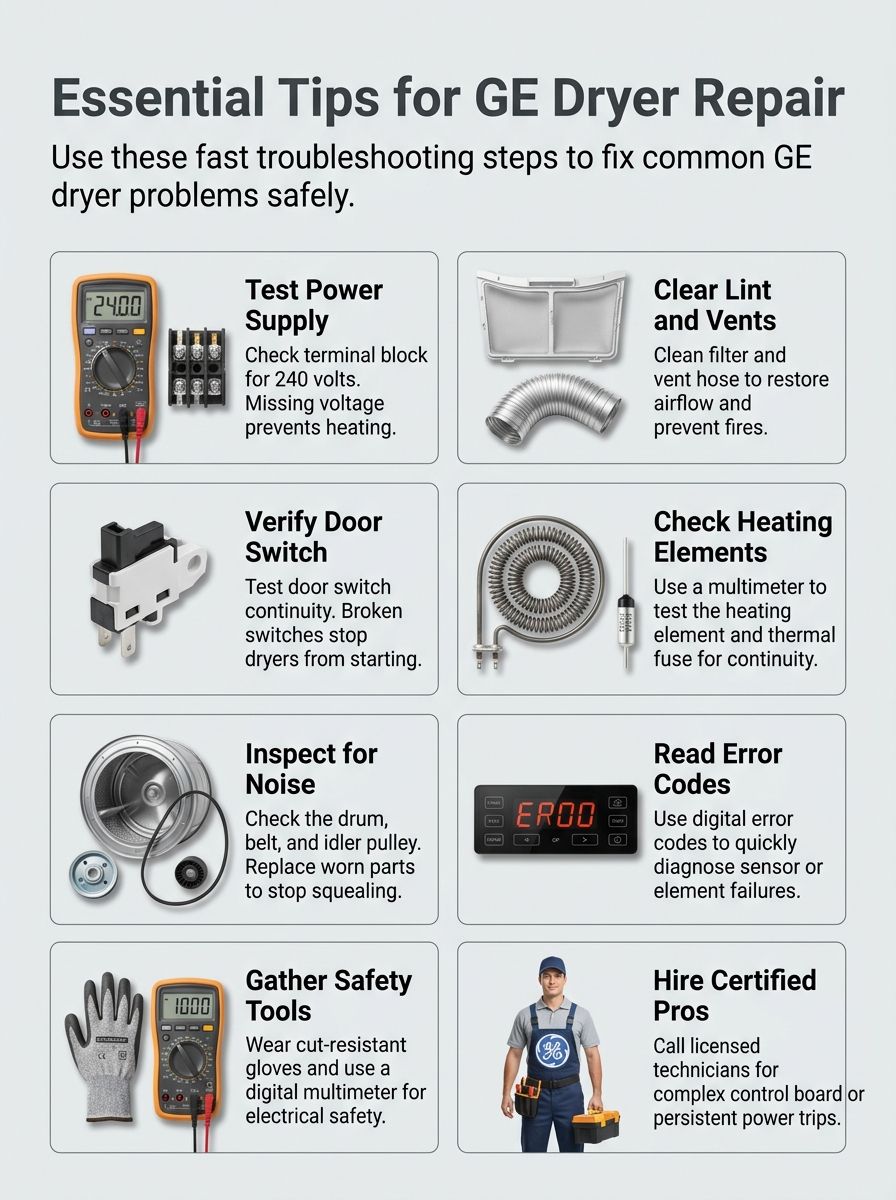
- Clean the lint screen and inspect the vent hose for kinks, lint mats, or crushed sections.
- Test voltage at the terminal block: about 120 volts from center to each outer leg, and full line voltage across the two outer legs.
- Test the heating element, thermal fuse, and high-limit thermostat for continuity after unplugging the dryer.
- For gas models, make sure the shutoff valve is open and listen for the igniter sequence.
- Do not ignore a door switch fault, because some GE dryers will not energize the heat circuit if the door circuit is not proving closed.
How Do I Fix a GE Dryer That Won’t Start?
When a GE dryer will not start, begin with the easy checks that cost nothing. Make sure the door is fully closed, the cycle is selected, and the breaker is fully reset.
On some electronic-control GE models, the panel can simply be asleep. GE owner guidance for certain models says pressing Start twice will recall the last cycle and wake the machine back up, which makes this one of the fastest no-start fixes to try.
- Open the door and check whether the drum light comes on, then test the outlet and breaker if it does not.
- Test the push-to-start switch for continuity if the button feels loose, sticks, or only works intermittently.
- Test the door switch and latch alignment, since a slightly shifted front panel can keep the switch from closing.
- Check the thermal fuse, because a blown thermal fuse is a common no-start part on overheated dryers.
- If the dryer only runs while you hold the start button, suspect the start switch, belt switch, or motor centrifugal switch.
If those checks pass, move on to the timer circuit or control board. That is usually the point where a meter and wiring diagram become essential.
What Causes a GE Dryer to Stop Mid-Cycle?
A dryer that stops mid-cycle is usually overheating, losing power, or failing to read temperature correctly. In practice, blocked exhaust is the most common reason the machine gets too hot and shuts itself down.
- Check the thermal fuse and cycling thermostat for continuity.
- Inspect the vent path from the lint housing to the outside hood.
- Reset the breaker and watch for another trip, because repeated trips point to an electrical problem, not a random glitch.
- Look for thermistor or sensor trouble if the display shows temperature-related faults.
- If the dryer restarts after cooling off, suspect restricted airflow, a weak motor, or a failing high-limit control.
If the same load keeps stopping in the same way after you clean the vent, stop running the dryer and schedule service. Repeated overheating can damage the heater housing, wiring, and control board.
Why Does My GE Dryer Make Excessive Noise?
The sound usually tells you where to look. Squealing and chirping point to the belt path, while scraping points to glides, the drum rim, or something trapped in the blower area.
| Noise | Most Likely Cause | What To Do |
|---|---|---|
| Squeal or chirp at startup | Worn idler pulley or dry drum rollers | Inspect the belt tensioner and roller shafts first. |
| Rhythmic thump | Flat-spotted roller or damaged belt | Spin the drum by hand and look for one bad spot in the rotation. |
| Metal scrape | Worn drum glides, rear bearing, or foreign object | Check the front drum support and blower housing for coins, bra wires, or zippers. |
| Rattle | Loose blower wheel, screw, or vent connection | Tighten hardware and inspect the blower wheel before replacing motor parts. |
As of April 2026, recent GE parts listings showed useful price clues for common noise repairs: the WE12X83 idler pulley was listed at $16.04, and the WE03X10008 drum support roller with axle at $53.48. That makes a quick pulley repair far easier to justify than a blind motor replacement.
What Do GE Dryer Error Codes Mean?
Error codes are helpful, but only if you match them to the exact model. GE uses different control boards across model families, so the same symptom can appear with different code language.
| Code Family or Display Clue | What It Usually Points To | Best Next Step |
|---|---|---|
| Clean Filter or airflow reminder | Restricted airflow, dirty lint screen, clogged vent, or a reminder message | Clean the filter, inspect the vent path, and make sure the outside hood opens freely. |
| Door or latch warning | Door switch, latch alignment, or wiring issue | Shut the door firmly, test the switch, and inspect the harness at the front panel. |
| Temperature sensor or thermistor fault | Failed thermistor, loose connector, or damaged wiring | Check the sensor harness and test resistance against the model-specific tech sheet. |
| Heating circuit fault | Open heater, thermal fuse, thermostat, or burnt wiring | Inspect the heater assembly and review common heating element failure patterns before ordering parts. |
| Main control or internal communication fault | Control board, relay, or harness problem | Record the full code, cycle, and symptom, then move to professional diagnosis. |
The safest habit is simple: write down the exact code, take a photo of the display, and search that code by full model number. GE says your model number always begins and ends with a letter, which helps you avoid ordering the wrong part.
Key Troubleshooting Steps for GE Dryers
Good troubleshooting starts with the checks that are fast, safe, and most likely to solve the problem. That order saves you from pulling the drum when the real problem is a breaker or blocked vent.
Use these steps before you book repair service or start buying parts.
Watch a step-by-step dryer diagnostics video
How Do I Check the Power Supply for My GE Dryer?
Power comes first because it can mimic almost every other failure. A dryer with one lost power leg can still light up, spin, and fool you into blaming the heater.
- Shut the dryer off and reset the double-pole breaker fully to OFF, then back to ON.
- Set your multimeter to AC voltage and test center to left and center to right at the terminal block for about 120 volts on each side.
- Test across the two outer terminals for full line voltage.
- Inspect the power cord and terminal block for heat damage, loose screws, or a burnt neutral.
- Do not keep testing a cord or outlet that shows burn marks. That is now an electrical repair issue.
- If the outlet reads wrong but the dryer wiring looks fine, bring in a licensed electrician before you go deeper.
If your dryer runs but has no heat, assume a supply problem until your meter proves otherwise.
How Do I Inspect and Clean the Lint Filter and Venting System?
Clean the lint screen after every load. That single habit protects drying performance, energy use, and fire safety.
GE Appliances notes that the Clean Filter reminder on some electronic models is a timed reminder, not a sensor-based warning. In other words, the message can show up even after you already cleaned the screen.
- Pull the filter, then wipe it with moistened fingers in a downward motion to lift lint off the mesh.
- Wash the screen in warm, soapy water if fabric softener residue has made it look shiny or waxy.
- Unplug the dryer and vacuum under the lint filter slot.
- Clean the vent run and ductwork with a vacuum hose or a brush kit, including the area where the duct exits the back of the dryer.
- Use the GE Appliances Brush Set, model PM14X10056, if you want a tool designed for dryer lint channels and short vent runs.
- Go outside while the dryer runs and confirm the vent hood flap opens freely.
GE installation guidance says the exhaust system should be inspected and cleaned at least once a year with normal use, and more often if you run frequent loads.
How Can I Test and Reset the Dryer’s Electronic Controls?
Electronic controls fail far less often than homeowners expect. Reset them first, then test switches and safety parts before you blame the board.
- Reset the breaker or unplug the dryer for a short power reset.
- Re-select the cycle and press Start again, because some GE controls go to sleep when left idle.
- If the dryer beeps twice and refuses an option, assume the setting is incompatible with the cycle before you assume a board failure.
- Inspect the board area for burnt relay spots, loose harness plugs, or moisture damage.
- Test the push-to-start switch, timer contacts, thermal fuse, and door switch before replacing the control board.
- Record every displayed code and symptom so you can compare them to the model-specific tech sheet.
Board replacement is usually a last move, not a first move. If a reset fails and your basic switches test good, that is the right time to consider professional service.
How Do I Verify the Dryer’s Door Switch Is Working Properly?
The door switch is a small part that causes big headaches. If the switch does not prove the door is closed, the dryer may not start, may stop early, or may act dead even with full power.
- Unplug the dryer before you remove any panel or switch harness.
- Close the door and test the switch for continuity according to the wiring diagram for your model.
- Inspect the latch strike, switch mount, and front panel alignment for cracks or looseness.
- Reconnect every wire firmly during reassembly, because a half-seated connector can mimic a bad switch.
- If the switch fails continuity, replace it with the correct model-specific part instead of trying to clean burnt contacts.
Take a phone photo before disconnecting the harness. That one habit prevents more reassembly mistakes than any tool in the bag.
How Do I Examine the Heating Element and Thermal Fuse?
Unplug the dryer and give yourself room to work before you open the heater housing. Label wires as you remove them, especially on GE platforms that use multiple blue or purple leads around the heater assembly.
- Inspect the heater housing for a burnt terminal, melted spade connector, or broken wire near the element.
- Test the heating element for continuity.
- Test the thermal fuse and high-limit thermostat for continuity.
- Check the harness for discoloration or loose female spade ends that can overheat under load.
- If you replace a blown thermal fuse, clean the vent system first or you may blow the new fuse again.
- After reassembly, run a short heated cycle and verify both airflow and temperature return to normal.
The fuse is the warning sign, not always the root cause. If the exhaust is still restricted, the new part will not last.
What Tools Do I Need for DIY GE Dryer Repairs?
You do not need a giant workshop for basic GE dryer repair. You do need the right meter, the right drivers, and enough safety gear to avoid cuts and electrical mistakes.
| Tool | Why It Matters | Best Use |
|---|---|---|
| Digital multimeter | Confirms voltage, continuity, and resistance | Power checks, fuse tests, heater checks, switch tests |
| 1/4-inch hex driver and Phillips screwdriver | Matches the fasteners used on many GE dryer panels | Front panel, top panel, heater housing, and bracket access |
| Needle-nose pliers | Helps with spade connectors and spring clips | Removing wires from thermostats, fuses, and switches |
| Vacuum hose and lint brush | Removes lint from hidden channels | Lint housing, blower area, vent outlet |
| Cut-resistant gloves | Protects hands from sharp sheet metal | Any cabinet or drum work |
| Phone camera | Acts like a reassembly map | Wire routing, harness position, screw location |
One overlooked pro tip: GE installation literature for some models places the wiring diagram under the top panel. Check there before you start tracing wires by color alone.
Watch the tool and teardown video
How Can I Fix My GE Dryer Myself?
You can handle many GE dryer repair solutions yourself if the job stays inside basic electrical testing and simple part replacement. Good DIY candidates include lint cleanup, thermal fuse replacement, door switch replacement, and some heating element jobs.
As of April 2026, recent GE Appliances parts listings showed how affordable some common repairs can be: the WE04X27360 thermal fuse was listed at $12.50, the WE4M416 push-to-start switch at $23.22, and the WE11X27362 heating element at $80.22. That is a useful reality check before you decide whether to repair or replace the appliance.
| Part | Example GE Part Number | Recent Price | Good DIY Candidate? |
|---|---|---|---|
| Thermal fuse | WE04X27360 | $12.50 | Yes, if you also clean the venting system |
| Push-to-start switch | WE4M416 | $23.22 | Yes, if access is straightforward and wiring is photographed first |
| Idler pulley | WE12X83 | $16.04 | Yes, if you are already opening the cabinet for a squeal repair |
| Heating element | WE11X27362 | $80.22 | Maybe, best for homeowners comfortable with wiring labels and continuity tests |
How Do I Replace a Faulty Heating Element?
Replacing a heater is very doable if you work slowly and label everything. The biggest mistakes happen during reassembly, not disassembly.
- Unplug the dryer and pull it forward for working space.
- Remove the access panel or front assembly your model uses to reach the heater housing.
- Photograph every wire before disconnecting it.
- Remove the heater housing fasteners and inspect for burnt wires, loose terminals, or cracked insulators.
- Install the new element, making sure it seats fully and no wire can rub the drum or housing.
- Reconnect wires, reassemble the cabinet, and run a short heat cycle while monitoring airflow.
If you find a melted connector, replace that terminal too. A new heater on an old burnt spade connection is a short-lived repair.
How Do I Reset a Tripped Circuit Breaker?
A dryer breaker must be reset firmly. A half-tripped double-pole breaker is easy to miss and can leave you with a running dryer that does not heat.
- Turn the dryer off before touching the panel.
- Move the dryer breaker all the way to OFF, then back to ON.
- Unplug the dryer if the breaker trips again immediately.
- Inspect the cord, outlet, and terminal block for heat damage.
- Test for proper voltage before assuming the internal dryer parts are bad.
- Call an electrician if the outlet or breaker shows damage or keeps tripping under normal load.
This is one of the simplest repair solutions in the house, and it is still one of the most overlooked.
How Do I Clean the Dryer’s Door Switch?
Cleaning the switch area helps when lint, sticky residue, or slight panel misalignment keeps the plunger from moving freely. If the switch body is cracked or fails continuity, replace it instead of trying to rescue it.
- Unplug the dryer and remove the panel needed to reach the switch housing.
- Brush out lint and debris around the switch and latch opening.
- Inspect the plastic lever or plunger for cracks, looseness, or signs of heat.
- Clean the area lightly and keep liquid away from the harness itself.
- Reconnect the harness securely and test continuity before full reassembly.
- If the switch still fails, replace it with the correct part and recheck door alignment.
A sticky switch can act like a bad control board. That is why I always test this part before recommending more expensive service.
When Should I Call a Professional for GE Dryer Repair?
Call a professional when the repair crosses into gas work, repeated breaker trips, motor replacement, or control board diagnosis. The same rule applies if you smell gas, smell burning insulation, or see signs of melted wiring.
Shut the dryer down immediately if it trips the breaker twice, shows burnt wiring, or overheats enough to smell hot. Those are safety problems first and repair problems second.
- Call for help if the dryer still will not start after you confirm power, door switch, and thermal fuse.
- Call for help if heater wiring has melted or the terminal block is scorched.
- Call for help if a gas dryer will not ignite or you suspect a gas supply problem.
- Call for help if the drum motor, control board, or harness needs deeper testing.
- Call for help if the dryer keeps blowing fuses after you clean the vent.
For Staten Island homeowners, reach emergency service at 646-204-3526. That gives you a fast path to GE dryer repair when basic troubleshooting no longer makes sense.
How Do I Choose a Reliable GE Dryer Repair Service?
The best repair company will make the decision easy for you. They should explain the fault clearly, show you the failed part when possible, and back the work with a written warranty.
What Factors Should I Consider When Hiring a Technician?
Use this checklist before you book a technician. It helps you separate a real appliance repair service from a generic handyman call.
- Confirm the company is licensed and insured for in-home appliance work.
- Ask whether they stock common GE dryer parts in their service inventory for first-visit repairs.
- Ask for the warranty length on both labor and parts, not just one or the other.
- Ask whether they use genuine GE parts or approved equivalents for older models.
- Check whether they offer same-day service for no-heat and no-start calls.
- Make sure the pricing includes a clear diagnostic policy and any service-fee credit if you approve the repair.
As of April 2026, our Staten Island service pages list same-day and emergency appointments, no service fee with completed repair, and about 90% of jobs fixed on the first visit. That kind of detail matters because it tells you how likely one appointment is to solve the problem.
What Are the Benefits of Professional Repairs Over DIY Fixes?
| Benefit | Why It Matters |
|---|---|
| Accurate diagnosis | A technician can separate a power issue, airflow issue, and part failure before money gets wasted on guesswork. |
| Safer electrical and gas work | Professional service is the smart move for breaker trips, gas ignition problems, and control board faults. |
| Warranty support | Written labor and parts coverage protects you if the same problem returns. |
| Faster turnaround | A stocked truck and a good parts inventory increase the odds of a same-day repair. |
| Better long-term value | A correct first repair prevents repeat failures caused by missed vent restrictions, weak connections, or wrong parts. |
DIY is great for maintenance tips and simple part swaps. Professional help wins when the repair is unsafe, time-sensitive, or still unclear after basic troubleshooting.
Related: Kenmore Dryer Repair Services
If you also own a Kenmore unit, the same troubleshooting mindset applies: start with power, airflow, and safety parts before blaming the main control. That makes brand-to-brand comparison much easier.
Our related Kenmore dryer repair services page is useful if you want to compare common parts, local service options, and warranty coverage across major dryer brands.
How Can I Prevent Future Problems with My GE Dryer?
Preventive maintenance is what keeps a simple appliance from turning into a repeat repair problem. Dryers respond well to small habits done on schedule.
What Are Regular Maintenance Practices for GE Dryers?
NFPA research has found that failure to clean is the leading factor in home clothes dryer fires. That is why good dryer maintenance is part safety routine and part performance routine.
- Clean the lint screen after every load.
- Wash the screen with warm, soapy water if you use fabric softener sheets and the mesh looks coated.
- Vacuum under the lint filter and around the blower area during routine maintenance.
- Inspect and clean the vent line at least once a year, or more often if you run frequent loads.
- Check the outside vent hood to make sure the flaps open and close freely.
- Inspect the power cord and terminal block for discoloration or looseness.
- Look at the belt path, rollers, and idler pulley if you hear new noise instead of waiting for a full failure.
- Have a technician vacuum internal lint from the cabinet during periodic service if you use the dryer heavily.
What Are Proper Usage Guidelines for GE Dryers?
How you load and run the machine affects drying issues more than most people realize. A healthy dryer can still perform badly if the load, cycle, and airflow choices are wrong.
- Do not overload the drum. Clothes need room to tumble freely or they will dry slowly and wrinkle more.
- Separate heavy towels and jeans from lighter fabrics so the sensor does not end the cycle too early for part of the load.
- Use Sensor Dry when your model offers it, because GE manuals describe it as more accurate than guessing with long timed cycles.
- Use small-load cycles like Speed Dry for just a few items instead of running a full sensor cycle.
- Clean the filter before each load if you want the best airflow and shortest run time.
- Check the vent path if collars, waistbands, or seams keep coming out damp.
- Use sanitize or anti-bacterial settings only on supported models and only for loads that can handle high heat.
- Act on unusual sounds, long cycles, and burnt smells early. Those are early warnings, not normal aging.
Conclusion
GE dryer repair gets much easier once you follow a clean order: check power, confirm airflow, test the safety parts, and only then move to switches, heater parts, or the control system.
With regular maintenance and timely service, you can prevent most drying issues, avoid repeat breakdowns, and keep your appliance working safely for years.
FAQs
1. How do I know if my GE dryer needs repair?
You need GE dryer repair if it stops heating, makes loud noises, or will not tumble. Check the power, clean the lint filter, and inspect the vent for blockages; if the issue continues, contact a certified technician for troubleshooting and solutions.
2. What services will a certified technician provide for GE dryer repair?
A certified technician will diagnose faults, replace failed parts, and perform vent cleaning and safety checks. They use genuine parts and provide a 1-year warranty on parts and labor, plus a written estimate before work.
3. How much does GE dryer repair usually cost?
Typical GE dryer repair costs range from $95 to $350, depending on the failed part and labor; you receive a clear estimate after the initial diagnosis.
4. How do I schedule GE dryer repair and what are the next steps?
Call 800-555-0199 or book online to describe your repair needs and choose a service time. The technician will run tests, explain the repair solution and price, complete the work if you approve, and record your warranty and service plan.
References
- https://pressroom.geappliances.com/news/cleaning-dryer-lint-filters
- https://www.justanswer.com/appliance/n3opz-reset-ge-dryer-running-dryer.html (2023-09-30)
- https://www.justanswer.com/appliance/jvwoo-ge-sensor-drier-doesn-t-start-cycle-plugged.html (2022-07-30)
- https://www.ifixit.com/Device/GE_Dryer
- https://repair.geappliances.com/resources/faq/article/dryer-maintenance-tips
- https://repair.geappliances.com/resources/ge-dryer