Appliance Repair Staten Island · Practical repair guide
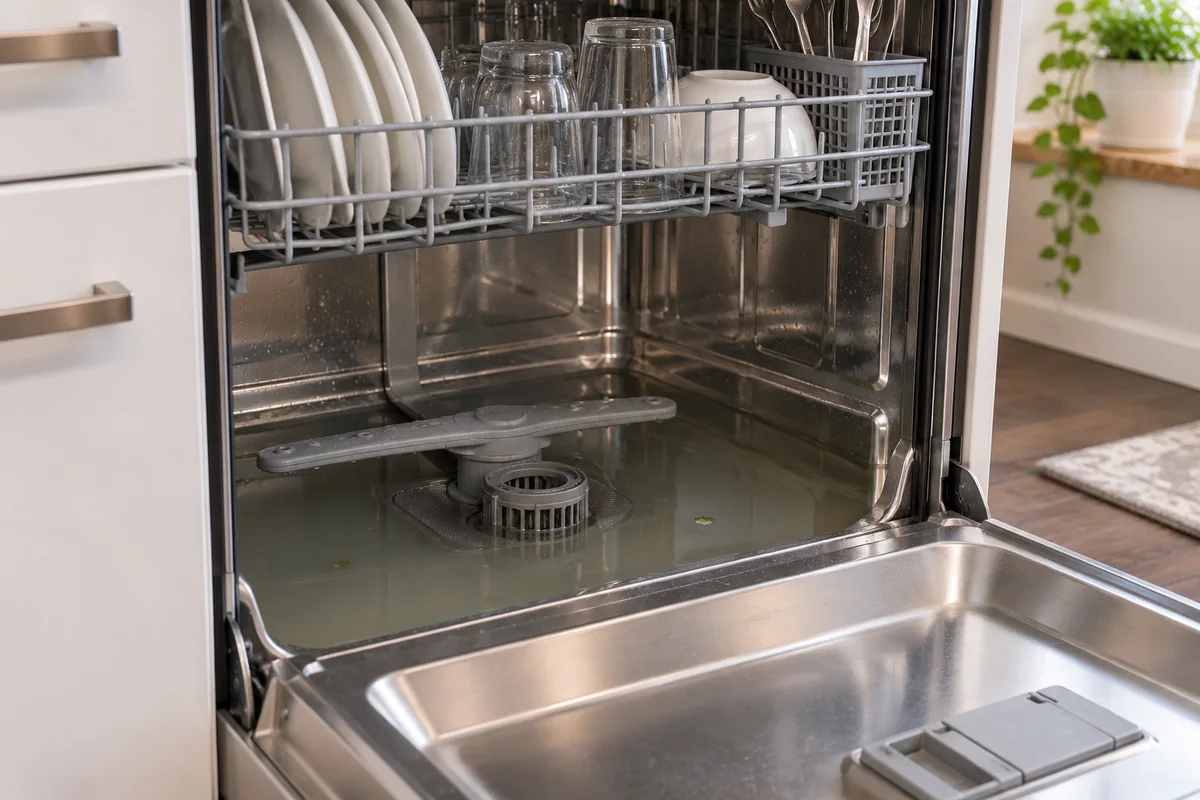
A dishwasher can finish its cycle and still have water in the bottom. The first thing to establish is whether that water belongs there. A little clean water in the recessed filter area can be normal on some machines. Water spread across the tub, dirty water left above the filter, or water that returns hours after the cycle has ended tells a different story.
If a completed cycle repeatedly leaves excess water, dishwasher repair in Staten Island can help establish whether the trouble is in the dishwasher or the drainage connection. There is little point replacing a pump if the water has nowhere to go.
How much water is normal?
Look at the water after the program has actually finished, not during a pause in the cycle. Dishwashers hold water while washing and rinsing, and different models have different sump and filter designs.
For example, GE Appliances explains that some of its machines without an ultra-fine filter can retain a small amount of clean water across the tub floor. On models with an ultra-fine filter, residual water may be expected within the recessed sump but should not cover the tub floor. That distinction is specific to the manufacturer’s designs; do not use the same water level as a universal specification.
What matters is a departure from your machine’s normal behavior. Is the water higher than it used to be? Is it cloudy or full of food particles? Does the dishwasher report a drain error? Are dishes still dirty? A photograph taken after the machine has stopped can be more useful than trying to estimate the depth from memory.
Water never leaves, or it leaves and comes back?
Both situations can look like a blocked dishwasher when you open the door. They point toward different parts of the drainage system.
| What you notice | What it may suggest |
|---|---|
| Water remains after the completed cycle | Restricted drain path, pump problem or a cycle that did not complete |
| Water goes away and later returns | Wastewater flowing back through the drain connection; a routing or check-valve problem is possible |
| The kitchen sink drains slowly too | A shared plumbing restriction may be involved |
| Water appears after installing a garbage disposal | The dishwasher connection, disposal inlet or hose installation may need attention |
| A new hum, grinding sound or drain error | The pump may be obstructed, failing or unable to move water through the drain path |
These are clues, not component diagnoses. A pump can sound as though it is running while water remains trapped downstream. Conversely, a quiet dishwasher may have finished a normal drain operation, or its control system may never have commanded the pump to run.
Follow the drain path
On a typical residential dishwasher, wastewater collects in the sump near the bottom of the tub. A drain pump sends it through a hose to the household drain, often through a sink connection or a garbage disposal. Some installations use an air gap at the countertop; others use a manufacturer-specified elevated hose arrangement. The installation instructions and applicable local requirements determine which arrangement is appropriate.
This explains why cleaning a filter sometimes fixes the complaint and sometimes changes nothing. The filter is only one part of the route. A restriction farther along the hose, a blocked sink connection or an internal pump problem may leave the same visible pool of water.
A particularly useful clue is the timing of the problem. If the dishwasher emptied correctly last night but contains dirty water after the sink was used this morning, investigate the possibility of backflow before assuming that the pump cannot drain. If the water remains from the moment the cycle ends, the investigation starts with whether the machine completed its drain stage and whether the path is open.
Checks you can make without moving the dishwasher
Start with the easy observations. If there is an active leak, a burning smell, an electrical fault or a tripping breaker, stop using the machine. Do not start another cycle just to reproduce the problem. Switch off the circuit from a safe, dry location if you can do so safely and shut off the water supply if it is safely accessible.
Check whether the cycle ended normally. An interrupted wash, open door or power interruption can leave water that would have been drained later. Consult the model’s instructions for its cancel/drain function. Use that function only when the appliance is safe to operate. If the water stays in place, avoid repeatedly restarting it.
Look at the sink. If the sink itself is backing up, adding more water to the system is unlikely to help. A plumber may need to resolve a shared drain restriction. A recently installed garbage disposal may also have a dishwasher inlet that was not opened during installation. Tell the installer or technician about the recent work; there is no need to disconnect the hose yourself to investigate it.
Inspect the accessible filter. With the dishwasher stopped, cooled and power disconnected according to its manual, check whether your model has an owner-removable filter. Clean it using the manufacturer’s instructions and reinstall it securely. Some older designs use a different filter system. Do not force parts that are not intended to be removed, reach into a concealed pump opening, or handle sharp debris with bare hands.
Observe the accessible hose routing. Under the sink, look for an obvious kink, compression, loose connection or evidence of recent plumbing work. Do not pull a built-in dishwasher forward or disconnect hoses. The absence of an obvious kink under the sink does not rule out an obstruction elsewhere.
Never pour a chemical drain opener into the dishwasher. It is not an appropriate way to clear an appliance’s internal water path and can damage components or expose you and a technician to hazardous liquid.
When cleaning the filter is not enough
Once the visible maintenance items have been addressed, repeated standing water deserves a proper diagnosis. The drain pump, an obstruction in the pump or internal hose, a check valve or a fault in the control circuit can prevent the expected movement of wastewater. Some models also have separate arrangements for circulation and draining; a dishwasher that washes effectively is not necessarily able to drain properly.
A technician needs to distinguish a restriction from a pump that is not being driven correctly, and a pump that runs but cannot move water. The model’s diagnostic information, the actual drain path and the condition of the components matter more than a generic replacement-parts list.
Water that escapes onto the kitchen floor is a different concern. Our guide to dishwasher leaks explains how the location and timing of a leak help narrow the investigation. Stop using the machine if water is escaping from it.
Make the next repair decision easier
Before arranging a visit, note the full model number if accessible, the program you used, whether the cycle ended, the amount and appearance of the remaining water, and whether the sink drains normally. Mention any recent installation or disposal replacement and record the error code exactly as displayed. If you already have a photograph of the water, keep it.
A drainage problem does not automatically mean a new dishwasher is needed. The decision depends on the confirmed fault, access, the condition of the appliance and the cost of the proposed repair. Knowing whether water never left the machine or returned later is a useful place to begin that conversation.
Call 646-204-3526 to discuss service availability in Staten Island. Have your model number and symptom ready; a diagnosis and repair price are provided before approved repair work begins.