Appliance Repair Staten Island · Practical repair guide
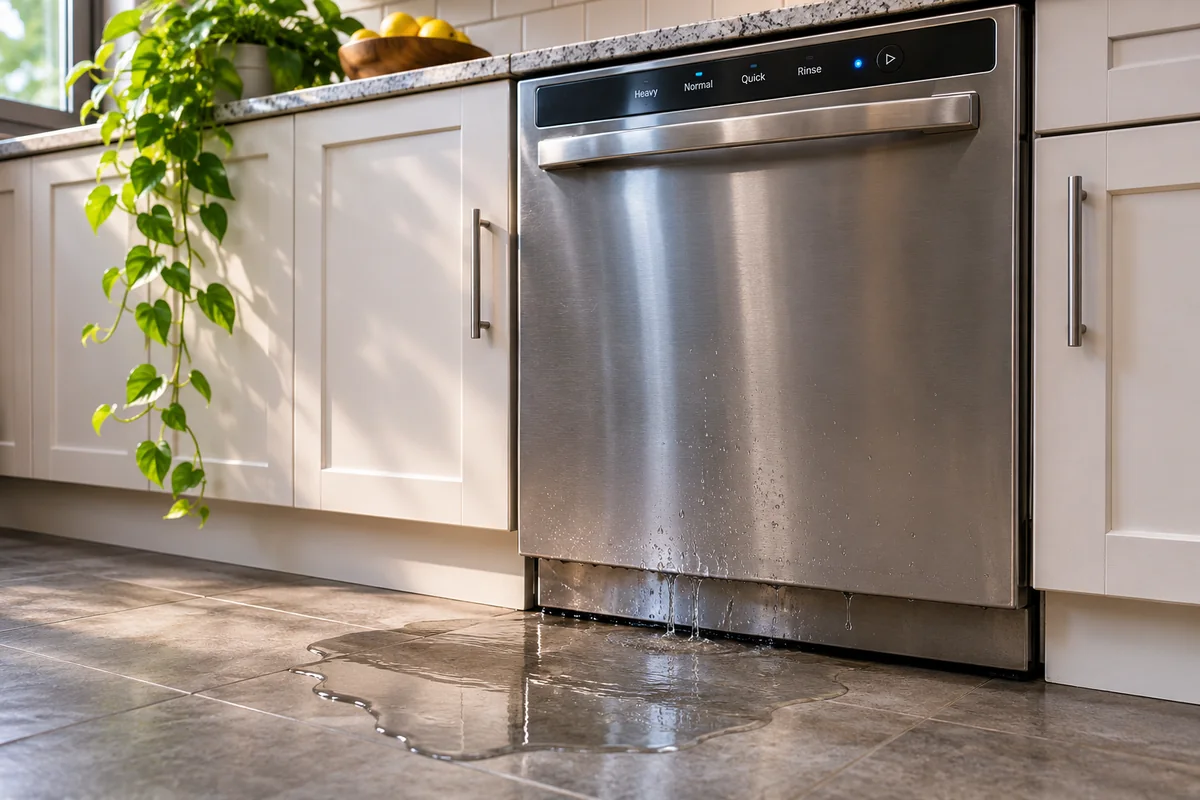
A puddle in front of the dishwasher does not necessarily mean the door seal has failed. Water can travel along the underside of the appliance, beneath the cabinets or across an uneven floor before it becomes visible. Where the puddle ends up and where the leak begins may be two different places.
If the dishwasher is actively leaking, stop the cycle and do not run it again to find the leak. Shut off the dishwasher’s water supply if you can reach it safely. If there is water near electrical connections, switch off power at the breaker only from a safe, dry location. Do not touch wet electrical equipment or remove service panels. If you cannot isolate the appliance safely, get professional help.
Start with the last place you saw water
A front-door leak usually calls for different checks than moisture that appears under the sink. Use what you can see without moving the dishwasher or removing any panels.
| Where moisture appears | Areas worth investigating |
|---|---|
| At the door edge or lower front corners | Door sealing, obstructions, excessive foam, water directed toward the door |
| Below the center of the machine | Internal water connections, pump seals, tub seals or another concealed leak point |
| In the cabinet under the kitchen sink | Water-supply connection, drain hose connection, disposal or surrounding plumbing |
| Behind the dishwasher or alongside cabinets | Supply or drain line, installation-related leak or water traveling from another source |
A dry door gasket does not establish that the appliance is safe. Likewise, water under the front edge does not establish that the gasket needs replacing. Before wiping away visible moisture, a quick photograph from a safe position can preserve useful evidence.
The time of the leak matters as much as the location
If you noticed when the water appeared, that detail can help distinguish several possibilities.
Before the cycle or while the machine was off. A supply connection can leak while it is under pressure, even when the dishwasher is not actively washing. Some inlet valve faults can also allow water into a machine when it should not be filling. A leaking kitchen sink or nearby water line may produce a similar puddle. Do not leave the dishwasher’s supply on simply to investigate an unattended leak.
During filling. The water inlet system and water-level control become more relevant. If too much water enters the tub, the overflow may appear near the door even though the underlying problem is elsewhere.
During washing. Water is circulating through the spray system. An obstructed or damaged spray arm, a dish preventing the door from sealing, excessive foam or a worn seal may allow water to escape. A leak that begins only when water is being circulated can also involve a component beneath the tub.
Near the end of the cycle. A drain hose connection or pump-related leak becomes a possibility as wastewater is sent toward the household drain. Moisture around the sink or countertop air gap may point to a drainage problem. If you also find excess water inside the machine after the program ends, the standing-water and drainage guide explains why a restricted drain and a leak can occur together.
The aim is not to recreate every stage. Report the stage you already observed. Controlled testing of a leaking appliance belongs in a properly equipped service diagnosis.
What an owner can inspect with the appliance stopped
A visible door seal is a sensible starting point once the machine is safe and the interior has cooled. Check for a piece of food on the sealing surface, a protruding utensil, or an obviously damaged or displaced seal. A new dishwasher may also have a door that contacts an adjacent cabinet before closing fully. Do not force the door or adjust the mounting hardware yourself.
Think about anything that changed just before the first leak. Was ordinary hand dishwashing liquid put into the dispenser? Did someone change the detergent or spill rinse aid? Was the dishwasher recently installed or the kitchen plumbing disturbed? Detergent intended for hand washing can create far more foam than an automatic dishwasher is designed to contain. Foam around the door and water on the floor can result even without a broken seal.
Look at the accessible cabinet under the sink without disconnecting the hoses. Report a wet fitting, a new disposal connection or evidence that water is coming from the sink plumbing. Do not reach behind the dishwasher, pull it out from under the counter, or remove the lower service panel while searching for moisture. Some components and electrical connections are concealed immediately below the tub.
A leakage code without a visible puddle
Certain dishwashers monitor for moisture in a lower area of the machine. For example, Samsung describes LE and LC as leakage-related codes on applicable models. A machine may try to keep draining when its protection system detects moisture, even if the kitchen floor looks dry.
An error code is worth recording exactly, including any flashing lights. The meaning depends on the brand and model. Turning a machine off may stop the noise, but it does not establish that the underlying leak has been resolved. Do not bypass a leakage sensor or repeatedly reset the appliance to keep using it.
What diagnosis should establish before replacing parts
A leak investigation starts with the installation, water connections and the part of the cycle associated with the complaint. The technician then checks whether the failure is in the seal, spray pattern, fill system, drainage components or another water-bearing assembly. A small damaged connection and a leaking pump assembly involve different repair decisions. A tub problem may require a different discussion again.
If water is reaching wood flooring or cabinetry, leave the dishwasher off until the source has been addressed. It is sensible to dry accessible surfaces promptly when you can do so safely, but a dry floor alone is not a repair. The next useful step is to identify the failed component or connection rather than guessing from the shape of the puddle.
For dishwasher repair in Staten Island, report where the water appeared, whether the appliance was running, any displayed code and any recent installation or plumbing work. Call 646-204-3526 for current appointment availability. The diagnosis and repair price are explained before the repair is approved.