
Why Sub-Zero Refrigerators Fail Differently Than Other Brands
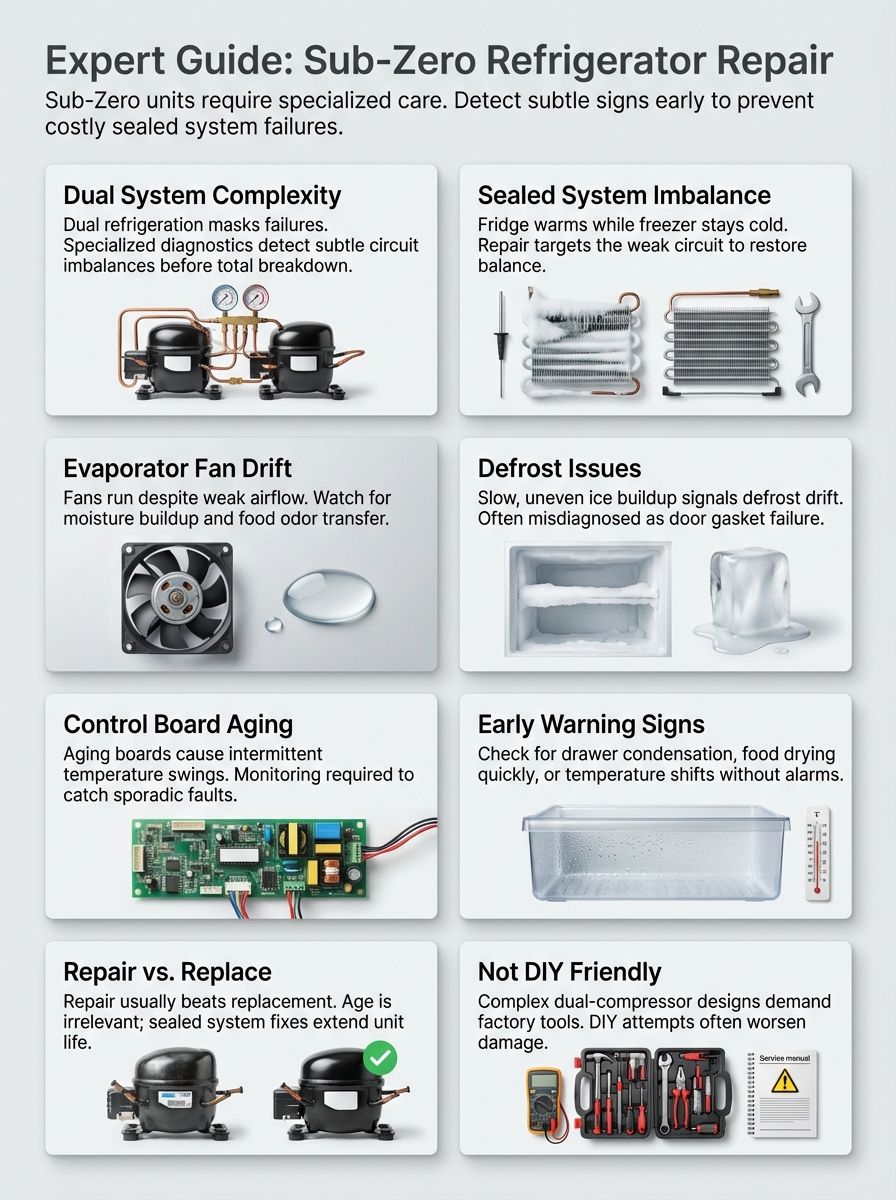
A Sub-zero refrigerator can look “fine” while your food quietly takes the hit.
That is the expensive trap with Sub-Zero. Many failures start as small efficiency losses, minor frost patterns, and subtle moisture, long before an alarm ever saves you.
I see it every week: owners wait until the unit “stops cooling,” then the repair gets bigger, slower, and harder to schedule.
If you want the fastest path to a reliable fix, start with a specialist and use the Sub-Zero and Wolf certified service locator to find trained help.
Do this next, in order:
- Confirm the doors close cleanly and nothing blocks the seal (bins, trays, food packages).
- Check for early symptoms like condensation near drawers, uneven frost, or new odors.
- Clean the condenser area if it has been neglected, then watch temps for stability.
- Book diagnostics early so the tech can catch “performance drift” before it becomes a sealed-system job.
Want a quick visual of the kinds of symptoms I’m talking about? Watch a short Sub-Zero repair walkthrough.
Sub-Zero is engineering-driven, not feature-driven
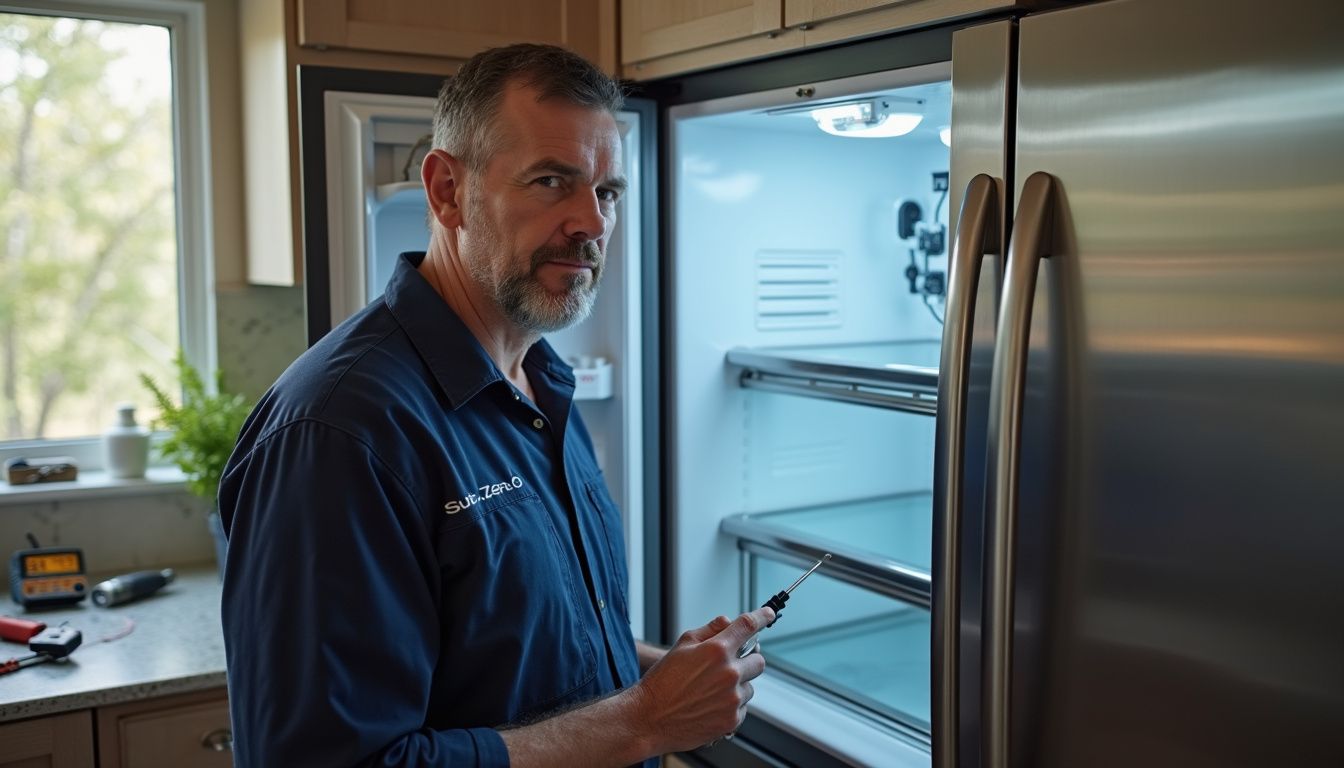
Sub-Zero is built around preservation, not gimmicks.
That shows up in the parts I test first: airflow balance, compartment isolation, defrost performance, and tight calibration.
I lead Appliance Repair Staten Island Inc., and I bring 25 years of high-end refrigeration repair to every call. I earned a Bachelor’s in Electrical Engineering from the National Technical University “Kharkiv Polytechnic Institute,” and I trained in Appliance Installation and Repair Technology at the Ideal Institute of Technology.
Engineering choices change repair needs and service time.
One reason is the control strategy. Sub-Zero’s materials and design focus on stable, predictable temperatures, and the controls store useful diagnostic signals that guide a targeted repair (instead of random part swapping).
If you want to see the “engineer’s view” of a Sub-Zero service call, watch this diagnostic-focused video.
Dual refrigeration systems change how failures appear
After emphasizing Sub-Zero engineering, I point out that dual refrigeration systems change how failures appear.
In practice, dual systems can “hide” a problem because one side keeps up while the other slowly falls behind.
That is why I troubleshoot by zone, not by guesses.
| What you notice | What it can mean in a dual system | What I do next |
|---|---|---|
| Freezer feels normal, fridge feels warmer | One circuit is losing capacity | Verify airflow first, then test sealed-system performance on the weak side |
| Condensation in the fresh-food section | Temperature swings or airflow restriction | Check fan performance, frost pattern, and defrost timing |
| Food dries out faster than usual | Humidity control is drifting | Inspect door seal, damper behavior, and evaporator airflow |
When symptoms get misread, owners lose days waiting on the wrong part.
Accurate diagnostics are what keep downtime short and results reliable.
If you want another visual reference, this short video shows how symptoms can differ by compartment.
Most Sub-Zero issues develop gradually, not suddenly
Problems in Sub-Zero refrigerators usually show up slowly over months or years.
I see decreased cooling efficiency and gradual frost accumulation as the most common “early stage” signs.
Here is the practical move: treat small symptoms like a scheduled repair, not an emergency.
- Take a quick photo of any frost pattern or condensation.
- Note what changed first (noise, ice production, fridge temps, freezer temps).
- Stop chasing settings resets, the pattern matters more than the button presses.
- Schedule service while the unit still runs, that is when diagnostics are easiest.
Certified technicians from our company handle these complex systems and perform the regular maintenance that keeps units running efficiently.
“Still cooling” does not mean “working correctly”
A Sub-Zero can feel cold and still fail.
Dual compressors feed the refrigerator and freezer separately, so one circuit can weaken while the other stays close to normal.
I have diagnosed units where the freezer read “fine” but the refrigerator dried food and showed condensation.
Sub-Zero’s own guidance says their products are designed to last about 20 years on average, which makes early, correct repairs worth it when the rest of the machine is healthy.
The Most Common Sub-zero Refrigerator Problems We See
Most Sub-zero service calls are not a dramatic breakdown.
They are a collection of small clues: a fan that still spins but moves less air, a defrost cycle drifting, or a control board acting “weird” once a day.
These are the problems I see most often:
- Sealed-system imbalance (capacity loss, not total failure).
- Evaporator fan performance drop that creates warm spots and moisture.
- Defrost issues that build hidden frost on the evaporator.
- Control board aging that causes intermittent swings.
- Ice maker and water system issues (slow fill, clumps, leaks, bad taste).
One fast way to speed up your repair is to give the tech your model and serial number up front. Sub-Zero lists the rating plate in common locations like inside the door near the top hinge on many full-size units, and inside drawers on column and drawer models.
My approach is simple: I diagnose performance drift first, then I fix the exact bottleneck that caused it.
Sealed System Imbalance (Not Total Failure)
One cooling circuit often loses capacity before the other.
I see refrigerators where the fridge section warms while the freezer seems normal, and it gets misread as a sensor problem.
To confirm a sealed-system imbalance, I check pressures, oil return behavior, and heat exchange performance.
The goal is to restore balance, not replace the entire system on a guess.
One cooling circuit weakens before the other
This shows up as “almost normal” cooling that cannot recover after door openings or grocery loads.
A pro-tip I always share is to watch recovery time. If the refrigerator section takes longer and longer to pull back down, the weak side is telling you a story.
Refrigerator section warms while freezer appears normal
I serviced Joyce’s Sub-Zero after she reported a warm refrigerator section while the freezer stayed normal.
The unit showed a normal freezer temperature yet rising refrigerator temps.
This pattern often links to capacity loss on one circuit and slow frost buildup that you do not see until airflow is already compromised.
- Do not keep resetting temperatures.
- Do not ignore new condensation around drawers.
- Do schedule diagnostics early, before the refrigerator crosses from “weak” into “unable to maintain.”
Often misdiagnosed as a settings or sensor issue
A weak sealed circuit can mimic a bad sensor or a wrong temperature setting.
Owners change controls and reset alarms, but the imbalance stays because the mechanical capacity is still low.
I run pressure and airflow tests to find the real cause.
That saves you from unnecessary part swaps and repeat visits.
Evaporator Fan Performance Degradation
Evaporator fans can keep running even as airflow decreases.
That reduction leads to uneven temperatures, extra moisture, and odor transfer between zones that should stay stable.
In many homes, this shows up slowly, so the owner adapts without realizing it.
- Listen for new squeaks, grinding, or intermittent fan noise.
- Feel for airflow at interior vents, not just “cold air in general.”
- Look for moisture collecting where it never used to.
I recommend inspection and cleaning first, then replacement if testing shows the fan is truly underperforming.
Fan still runs but airflow weakens over time
I inspect Sub-Zero units that show a running fan with weak airflow.
Fan blade wear, motor weakening, or duct obstruction can all reduce effective circulation, even if the fan never fully stops.
Proper testing checks fan performance and the airflow path before ordering parts.
Next, I cover defrost operation that often sits outside the ideal range.
Leads to uneven temperatures, moisture buildup, food odor transfer
I repaired a 2012 Sub-Zero that showed uneven temperatures and heavy moisture near the drawers.
The evaporator fan had weakened, and the refrigerator section warmed while the freezer stayed cold.
Moisture and odor issues can snowball fast once airflow drifts, so this is a high-return fix when caught early.
Common in units 8–12+ years old
Sub-Zero units in the 8 to 12 year range often hit the “wear curve,” where fans, seals, and controls start showing age.
That does not mean the unit is near the end. It means maintenance and precise diagnostics matter more.
In Staten Island service calls, evaporator airflow is one of the first things I verify.
Defrost System Operating Outside Ideal Range
Ice can build slowly and unevenly when the defrost system drifts.
Hidden frost on the evaporator reduces airflow, which then creates moisture and warm spots that look like other problems.
Technicians sometimes blame the door gasket first, but frost patterns can be caused by airflow, controls, or defrost timing.
If you see recurring frost patterns, fix the cause, not the symptom.
System works, but not within factory tolerances
This is the frustrating one: the unit “works,” but food quality drops.
I measure airflow and cooling cycles over time, because a quick glance can miss an out-of-range pattern.
Calibration and targeted parts replacement stop repeat issues and repeat service calls.
Ice accumulation develops slowly and unevenly
I have seen ice accumulate slowly and unevenly inside Sub‑Zero refrigerators over months while the freezer looks normal.
Two common contributors are poor airflow from a restricted path and a condenser that has not been cleaned in a long time.
I check minor frost signs promptly, because frost is usually the first visible sign of a bigger airflow problem.
Frequently confused with door gasket problems
I often find frost that looks like a bad gasket.
The seal can look fine, but ice builds where airflow is weak.
- Check hinge alignment and confirm the door closes smoothly.
- Clean the gasket surface so it can seat properly.
- If the gasket tests good, inspect the defrost heater and defrost control behavior.
Next, I cover control board aging and intermittent behavior.
Control Board Aging causes Intermittent Behavior
Control boards rarely fail in one clean moment.
They age, then show intermittent symptoms: odd temperature swings, unexplained “service” messages, or behaviors that vanish before a tech arrives.
I diagnose these cases by monitoring voltage, relay cycles, and sensor response patterns over time.
A quick part swap is risky on intermittent failures, because it can mask the real issue and waste money.
Rarely fails all at once
I see control boards wear out slowly and act unpredictable.
One day looks normal, then the next day you see a temperature swing with no obvious reason.
Early checks, while the problem is still small, reduce both downtime and cost.
Causes inconsistent cooling, unexplained temperature swings
Intermittent faults can create a strange mix of warm zones and icy spots.
I diagnose control boards and sensors when cooling swings appear, then I verify airflow and defrost status to avoid misreads.
“Strange behavior” complaints are common
“Strange behavior” is one of the most common phrases I hear from Sub-Zero owners.
Here is the trap: if you keep resetting the unit, you erase the pattern you need to diagnose.
- Write down when the issue happens (morning, evening, after heavy door openings).
- Photograph any message on the display.
- Stop changing settings, let the symptom repeat so it can be measured.
Early detection saves hours and prevents larger sealed system repairs.
Sub-Zero Design Trade-Offs Owners Should Understand
Dual systems preserve food better, but they raise the technical bar for repairs.
Separate circuits age at different rates, so one can weaken without total failure.
I use specialized tools and sealed-system skills to make correct fixes, and I plan repairs carefully instead of forcing a “quick swap.”
Next, I’ll cover the early warning signs most owners miss.
Why dual compressors improve food preservation
Dual refrigeration lets the refrigerator and freezer operate as separate sealed systems.
This helps prevent odor transfer between compartments and supports better preservation conditions for each zone.
It also explains why “one side seems fine” is not a clean bill of health.
Why Sub-Zero repairs are more technical
The separate system design improves preservation, but it increases diagnostic complexity.
I test two circuits, verify airflow per zone, and confirm defrost performance before I order parts.
That is how I avoid the most expensive mistake in high-end repair, replacing the wrong component first.
Why these units are not DIY-friendly by design
Sub-Zero systems use sealed refrigeration circuits and strict calibration.
In the U.S., the Environmental Protection Agency requires Section 608 certification for technicians who service equipment that could release refrigerant.
That is one big reason I do not recommend homeowners attempt sealed-system work or refrigerant handling.
- DIY sealed-system work risks contamination, leaks, and costly repeat failures.
- Control calibration without proper testing tools often creates new problems.
- Incorrect parts or fitment can damage panels, hinges, and cabinetry.
Repair Complexity
Sub-Zero units are engineered for longevity, but longevity depends on correct service.
Parts sit behind panels and brackets, and access can be tight inside custom cabinetry.
Genuine OEM parts can cost more, yet they restore correct airflow and humidity control when installed properly.
Sub-Zero’s own history notes key reasons these repairs are different, including the introduction of dual refrigeration in 1955 and cabinet-flush built-ins in the late 1950s.
Early Warning Signs Most Sub-Zero Owners Ignore
Light condensation near drawers, subtle temperature fluctuations without alerts, and slow ice buildup in freezers are the signs I want you to act on.
Those clues are your chance to fix a small fault before it turns into a sealed-system repair.
Sub-Zero’s temperature guidance is clear: 38°F for the refrigerator and 0°F for the freezer are the ideal targets, and food storage above 45°F is not safe.
- Condensation often points to airflow or temperature instability.
- Odd frost maps often point to defrost drift or restricted circulation.
- Food drying out often points to humidity control problems.
Light condensation near drawers
Moisture near the lower drawers is a common early signal.
The cause often traces to weak airflow, door seal issues, or slow defrost performance.
I check airflow first, because airflow problems create condensation long before a unit “fails.”
Subtle temperature fluctuation without alerts
Condensation near drawers often precedes small temperature swings.
Those swings can happen without an alert or obvious error code.
I inspect the dual systems, fans, and controls in that order so the real cause shows itself.
Food drying faster than usual
When food dries out faster than usual, I check door seals, damper behavior, and evaporator airflow.
Even a small airflow change can pull moisture out of greens, cheeses, and deli meats quickly.
Uneven frost patterns in the freezer
Uneven frost patterns often point to airflow restriction or a defrost problem, not just a “bad gasket.”
I map the frost pattern, listen for fan changes, and check for airflow restrictions that cause cold spots.
If you see repeated frost that keeps returning after a basic cleanup, schedule diagnostics instead of waiting for a full freeze-up.
Repair vs. Replacement: How the Decision Works for Sub-Zero
With Sub-Zero, the real question is rarely “Is it worth fixing?”
The real question is “How early was the issue caught?”
Because many problems develop gradually, early diagnosis changes outcomes dramatically.
| Situation | Repair usually makes sense when | Replacement starts to make sense when |
|---|---|---|
| Cooling is drifting, but the unit still runs | Diagnostics find a fan, defrost, seal, or control issue | Multiple major systems are failing at once |
| Suspected sealed-system issue | The cabinet is in good shape and parts are available | Parts are unavailable or repeated sealed-system failures occur |
| Owner wants a quick decision | Costs stay in line with a targeted repair plan | Total projected cost approaches a meaningful portion of replacement |
For a reality check on general repair pricing, 2025 consumer cost data compiled by HomeGuide puts many sealed-system refrigerator repairs in the hundreds to low thousands, and luxury built-ins can run higher depending on parts and labor.
Replacement thresholds are different for Sub-Zero
Sealed-system work on Sub-Zero can cost more than mass-market repair.
It can also restore years of reliable performance when the unit is otherwise healthy.
I assess compressor health, leak risk, and part lead times before recommending replacement.
Sealed system repairs often make financial sense
Repairing the sealed system can cost far less than replacing a built-in unit.
The key is speed: catch it early, fix it correctly, and avoid repeat contamination or repeat leaks.
That is why I push diagnostics at the first sign of drift.
Age alone is not a deciding factor
I judge each repair on symptoms and parts condition, not age alone.
A ten-year-old compressor can still run well, while a five-year control board can fail intermittently.
Early diagnosis drastically changes outcomes
Early diagnosis drastically changes outcomes.
When I catch small signs fast, I can often prevent damage from spreading into more expensive sealed-system work.
Monitoring performance and acting early protects the investment you made in your kitchen.
Sub-Zero Models and Configurations We Service Most Often
Early diagnosis works best when I identify the exact model fast.
Built-in column units, classic side-by-side models, and older integrated configurations all have different access points and airflow paths.
That changes labor time and parts planning, so model identification is not a small detail.
Suggested Steps on Sub-Zero Expert Booking:
- Before you call: locate the rating plate so parts can be matched correctly.
- During the call: describe symptoms by zone (fridge, freezer, drawers).
- After booking: avoid changing settings repeatedly, preserve the pattern.
Built-in column units
I service built-in column units frequently and inspect cabinet-flush models for airflow and alignment.
Tall, separate columns need precise calibration and routine airflow checks to prevent uneven cooling and moisture buildup.
Classic side-by-side models
I often see older side-by-side Sub-Zero units show freezer-first or fridge-first symptoms.
Restricted airflow or a weakening circuit usually causes the imbalance, not a simple thermostat error.
My tests focus on airflow, frost pattern, and performance recovery after door openings.
Older integrated configurations
Older built-in and integrated-style Sub-Zero configurations can date back decades, and they often require careful access planning.
These units helped define the cabinet-flush category, which is also why repairs can involve cabinetry protection and longer diagnostic steps.
Some Factory Certified Service providers offer yearly maintenance plans for older models, which can be a smart way to prevent the slow failures that ruin food and create emergencies.
What Makes Sub-Zero Repair Different From Other Refrigerators
Sub-Zero repair is system-level diagnosis.
Dual refrigeration and preservation-focused controls mean I treat airflow and calibration as core tasks.
Parts can have lead times, and accurate diagnosis often takes longer than swapping a component.
I plan repairs so the fix is stable, not temporary.
Part Replacement Time
I spend more time diagnosing Sub-Zero units than swapping parts.
Dual compressors and separate cooling circuits force careful testing.
A full diagnosis can take one to two hours for complex behavior.
- I trace airflow and look for restrictions.
- I inspect seals, filters, and condenser condition.
- I test each circuit’s performance before ordering parts.
I complete 90% of repairs on the first visit because I diagnose before I order parts.
My team holds Sub-Zero and Wolf certifications and we provide a minimum 30-day warranty.
Same-Day Fixes
Same-day service is great when temperatures are rising, but “same-day guessing” is not.
For non-urgent issues, planning lets a technician arrive with the right parts and the right testing tools.
If you need a quick visit, call us today.
Parts availability and lead times
Sub-Zero parts often come from specialized distribution channels, and lead times can vary.
I order parts as soon as I confirm the fault, because waiting to “see what happens” usually extends downtime.
Importance of Proper Airflow and Calibration
Proper airflow and calibration keep food fresher and reduce moisture problems.
These units are engineered for tight performance, so small deviations create noticeable food quality issues.
I plan repairs around parts availability and specialized tools to avoid damaging custom cabinetry.
Sub-Zero-Specific FAQ
These are the Sub-Zero questions I get most.
Why does my Sub-Zero cool but food still spoils?
The unit can move cold air and still spoil food if the refrigerator side is drifting, airflow is restricted, or defrost is building hidden frost.
One circuit can weaken while the other holds closer to normal, especially in dual systems.
Routine maintenance includes condenser cleaning, seal checks, and timely service when symptoms first appear.
Can one compressor fail before the other?
Yes.
Each compressor serves its own circuit, so wear or a small leak can hit one side first.
That is why I test by zone and confirm which side is truly weak.
Is it normal for freezer temperature to be lower than the set point?
I often see temporary swings colder than the set point after heavy door openings or after a defrost event.
Persistent offsets can point to sensor drift, airflow imbalance, or calibration issues that need testing.
Why do Sub-Zero repairs cost more even for minor issues?
Repairs can cost more because Sub-Zero uses specialized parts and factory-specific diagnostics, and access can be time-consuming in built-in installs.
Sealed-system work also requires certified refrigerant handling and long test times to confirm a stable fix.
My goal is to make every dollar count by diagnosing first, then fixing the true root cause
Catch minor Sub-Zero issues early and save time and money.
Cleaning the condenser and checking door seals are simple steps many homeowners can handle, and they prevent a surprising number of problems.
If something feels off, schedule a diagnostic before food loss and frost patterns get worse.
Sub-Zero issues are far easier to fix when identified early.
Early detection makes repairs faster and less costly.
During routine maintenance, my technicians clean condenser areas and check door seals, because those two steps protect airflow and efficiency.
I offer a minimum 30-day warranty on parts and labor for repairs.
If something feels “slightly off,” it usually is.
I inspect Sub-Zero units across Staten Island and find that small changes often signal real faults.
I bring over 25 years of experience and offer flexible appointments plus emergency support at 646-204-3526.
If you want fast, reliable Sub-zero repair, act on the first symptom and book diagnostics now, not later.
References
- https://www.subzero-wolf.com/assistance/answers/sub-zero/common/differences-between-subzero-refrigerators-and-other-brands
- https://www.subzero-wolf.com/why-sub-zero-wolf-and-cove-are-worth-it/performance
- https://www.subzero-wolf.com/assistance/answers/sub-zero/common/warm-refrigerator-or-freezer-troubleshooting