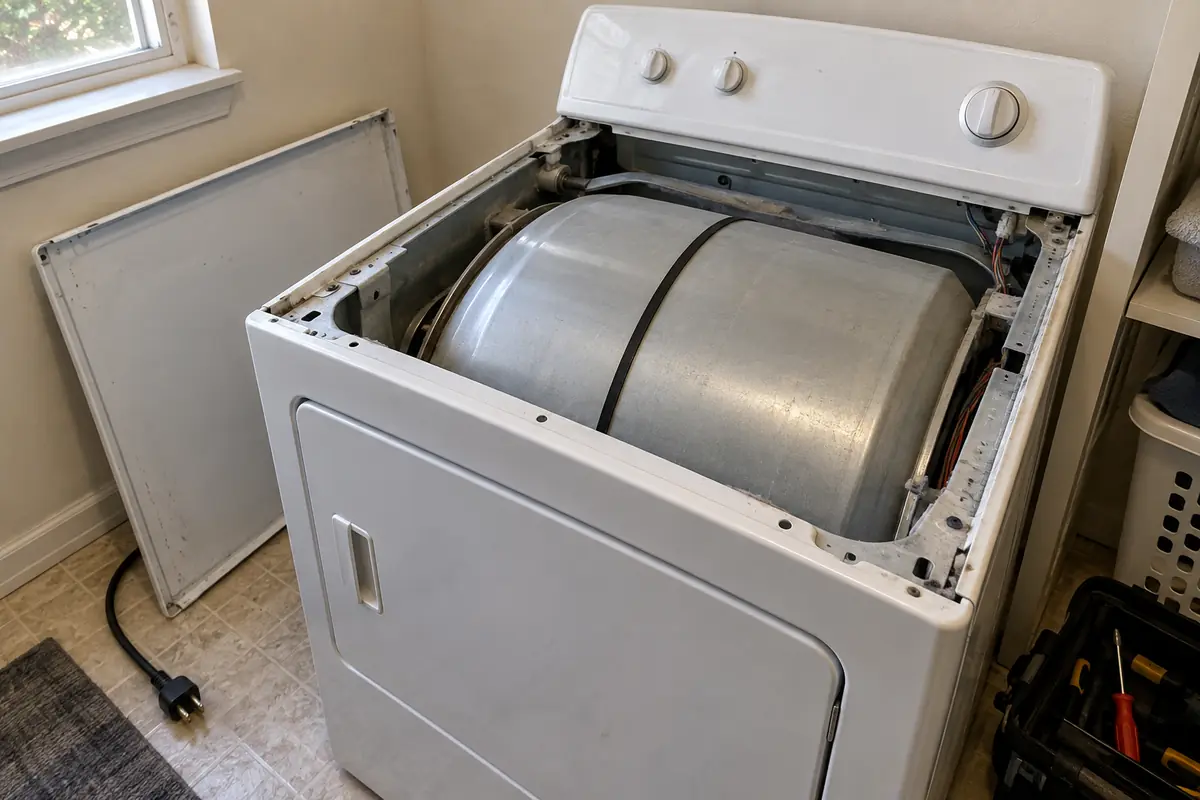
Appliance Repair Staten Island · Practical repair guide
First separate “will not start” from “appears to run but does not tumble.” Lights and a countdown do not prove the motor is running. A closed-door starting problem and a mechanical drive problem need different checks.
Describe what happens when you start a cycle
| Observation | Why it matters | What to report |
|---|---|---|
| No lights or response | The starting point may be power or controls | What is unresponsive and whether there was a recent power event |
| Lights respond, but the cycle does not begin | Settings, door/latch or a starting-system fault may be involved | Any lock indicator, exact message or beep |
| Cycle appears active; you hear a hum; drum stays still | A drive or motor-related problem needs investigation | Whether the sound stops when the cycle is cancelled |
| No rotation follows a new squeak, thump or scrape | The earlier noise can help guide the mechanical inspection | The sequence of symptoms, not an assumed broken part |
A dryer’s interior light is only one observation. Likewise, a humming sound is not proof that the motor is turning. Avoid describing it as “the belt is broken” unless that failure has actually been confirmed.
Check the door and controls using your manual
With the appliance stopped, make sure laundry is not caught in the door opening and that the door closes normally. Do not slam it or force a damaged latch.
Check whether Control Lock, a delay option or a non-running setting is selected. Use the owner’s manual to start the chosen cycle. Some models require a sustained press; there is no universal button sequence for every dryer.
If a code appears, photograph it and note whether it occurs before starting or during the cycle. Repeated resets may remove useful information without correcting the fault.
Why a drive problem is not always just a belt
In a belt-driven dryer, failure along the drive path can interrupt rotation. A starting or motor issue can produce a similar complaint. The appropriate checks depend on the model’s drive, door and safety systems.
Accessing those components is service work. Do not remove panels, bypass a door switch or hold the drum to “help” it start. Avoid repeated start attempts when the machine only hums or the drum appears stuck.
If noise came first, the noise guide explains what observations are useful. The history may matter more than the most recent symptom alone.
Prepare information and access for the visit
- Full brand and model number, preferably a clear label photo.
- Gas, conventional electric or ventless type, if known.
- What the controls display and what you hear after selecting Start.
- When the symptom began and whether the dryer recently moved.
- Stacked installation, tight closet or other access limitation.
Leave enough ordinary room access for the appointment, but do not unstack or disconnect the machine yourself. Our dryer repair service includes diagnosis before the repair price is approved. Parts and timing depend on the confirmed model and fault.
What if it starts again later?
An intermittent return to operation is useful history, not proof that the fault has resolved. Report whether it starts from cold, stops after a period of use or behaves differently with another cycle. Do not run repeated tests with a loaded drum to provoke the failure.
Once the cause is established, compare the proposed repair with the condition of the rest of the machine. A non-turning drum alone does not establish that the dryer needs replacement.
Manufacturer references
These references explain general operating checks. Use the instructions for your exact model; a guide cannot identify a failed part remotely.