
A “good enough” laundry pair can quietly cost you money, time, and repeat repairs. If you want the best washer and dryer for your home, you need more than a brand name.
I see the same failures on service calls, short cycles that do not clean, loud spins, musty odors, and sudden no-drain breakdowns.
I’m Eugene, and I lead Appliance Repair Staten Island Inc. After 25+ years in appliance repair, plus an electrical engineering background, I’ve learned which features actually hold up and which ones create headaches.
Use this guide as your buying plan, then follow the maintenance steps to keep your set running strong.
Key Points
- Efficiency is real money: ENERGY STAR notes certified clothes washers use about 20% less energy and 30% less water than regular washers. Pick an efficient washer first, because it also reduces dryer workload.
- My best overall for most homes: The LG WM4000H/DLEX4000 set balances strong cleaning, quiet operation, and a practical 4.5 cu ft capacity for everyday family laundry.
- Best for stain fighters: The Electrolux 700 Series uses SmartBoost (pre-mixes detergent with water) plus Perfect Steam options for tough soils, and it’s listed as ENERGY STAR Most Efficient on many configurations.
- Best top-load for pets: Maytag states the Pet Pro Filter removes 5x more pet hair, and the matching dryer’s XL lint trap is built to capture pet hair you do not want in your vent.
- Best small-space upgrade path: If you need a compact, ventless setup, the Miele WXR860WCS/TXR860WP pair delivers premium fabric care in a 24-inch footprint, but you pay more per cubic foot.
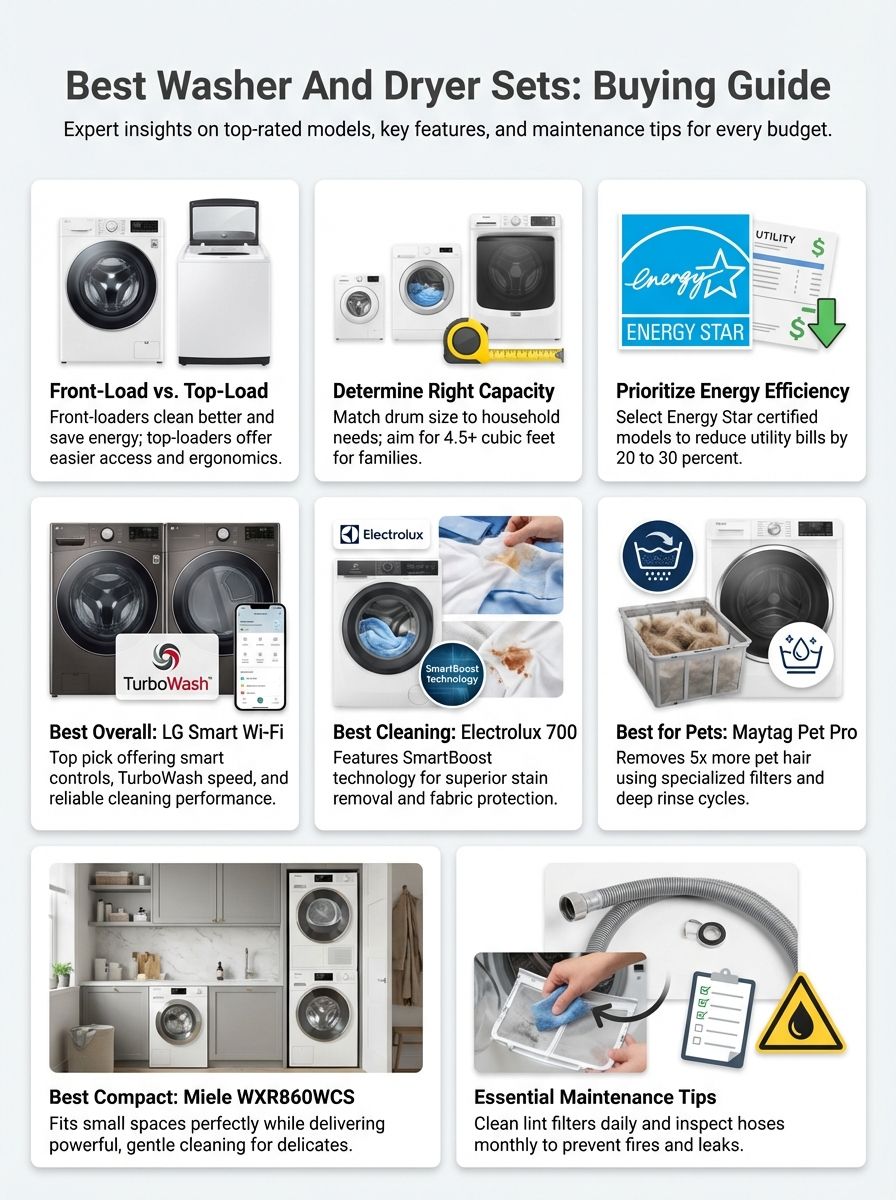
Key Factors When Choosing the Best Washer and Dryer Set
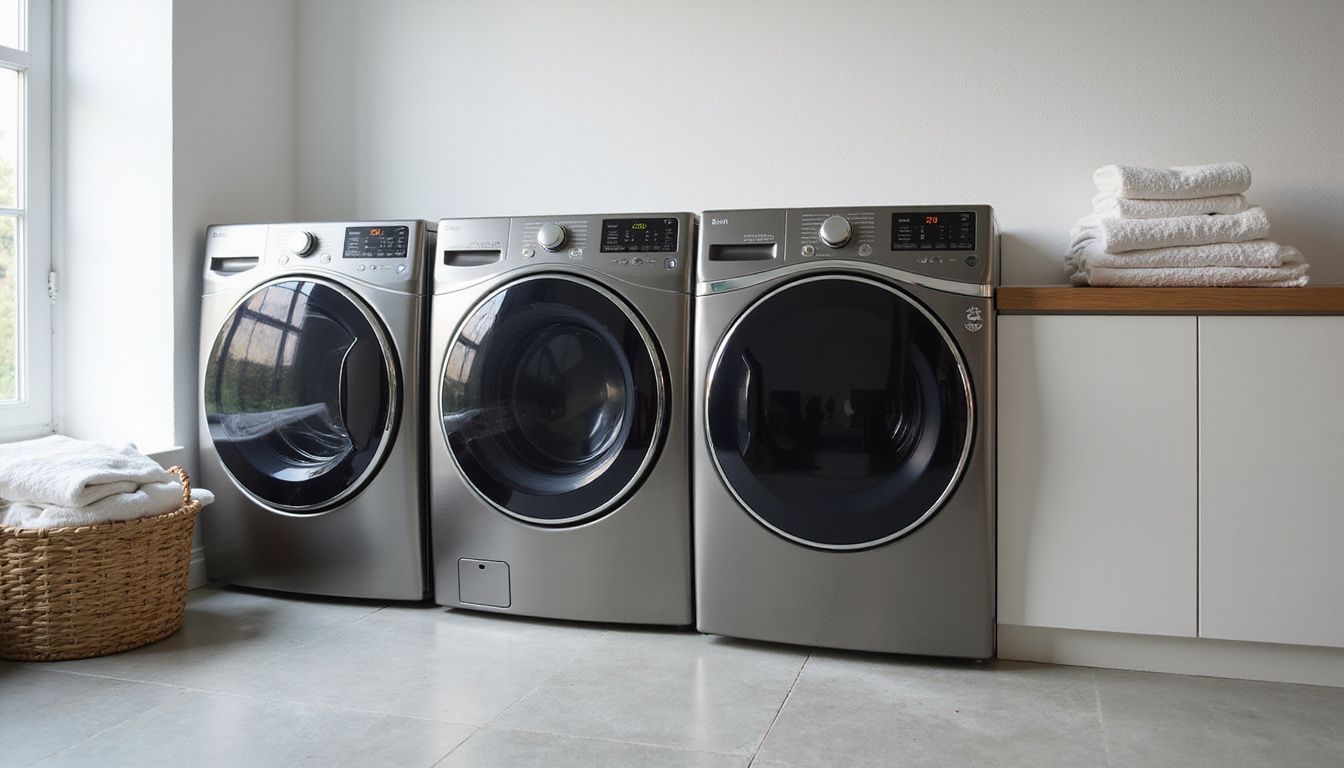
The right set is the one that fits your space, cleans the way your household actually lives, and stays affordable to own.
If you want a quick walkthrough before you read the details, use this video as a visual guide:
Watch the washer and dryer buying factors video
What are the differences between front-load and top-load washers?
Front-load washers usually win on cleaning, stain removal, and fabric care, because tumbling lifts and drops clothes through a smaller pool of water.
ENERGY STAR highlights a big efficiency gap: certified front-load washers use about 45% less energy and 50% less water than a top-load agitator washer, and they are still about 25% more efficient than a top-load impeller washer.
If you want a fast, decision-ready view, use this comparison:
| What you care about | Front-load | Top-load (agitator) | Top-load (impeller) |
|---|---|---|---|
| Water and energy use | Lowest (often the best pick for long-term bills) | Highest (deep-fill cycles raise use even more) | Middle ground |
| Cleaning and stain removal | Excellent, gentler on fabrics | Good for heavy soils, but rougher on clothes | Good, can vary by model |
| Odor and gasket care | Needs routine wipe-down and airflow | Usually simpler to keep fresh | Usually simpler, still benefits from cleaning cycles |
| Ergonomics | Can be stacked or raised on a pedestal | Easier access, less kneeling | Easier access, less kneeling |
My repair-side advice is simple: choose front-load if you want the best efficiency and fabric care, then commit to basic gasket and drain care so odors do not start.
How do I decide on the right washer and dryer capacity?
Start with your household size, then think about what you wash weekly, especially bedding, towels, and pet blankets.
As a practical baseline, a 4.5 cu ft washer fits most homes. For example, LG lists its 4.5 cu ft WM4000 series as “ultra large capacity,” and it’s commonly sized for bulky loads without forcing daily laundry.
Use this sizing cheat sheet (and keep the dryer close in capacity so the load tumbles freely):
| Household | Washer capacity target | Dryer capacity target | What this avoids |
|---|---|---|---|
| 1 to 2 people | 2.3 to 4.4 cu ft | 3.5 to 7.0 cu ft | Overspending on size you never use |
| 3 to 4 people | 4.5 to 5.0 cu ft | 7.0 to 7.4 cu ft | Overstuffed drums and long dry times |
| 5+ people, lots of towels, sports, pets | 5.0 to 6.0 cu ft | 7.4 to 9.0 cu ft | Multiple loads for one “family-size” day |
| Apartment, condo, tight closet | 2.0 to 2.6 cu ft (compact) | 4.0 to 4.5 cu ft (compact) | Bad fit, blocked doors, impossible servicing |
One more repair-friendly tip: leave clearance. I want enough room to reach the drain hose, shutoff valves, and vent connection without pulling the machine out like a stuck drawer.
Why is energy efficiency important and what certifications should I look for?
Efficiency is not “green talk,” it is fewer gallons, fewer kilowatt-hours, and less heat stress on parts.
Energy Star certified washers and dryers are the quickest shortcut to better operating costs. ENERGY STAR also notes certified washers can save about $530 in energy costs over the product’s lifetime, and certified electric dryers can save about $210 over their lifetime.
- ENERGY STAR label: Confirms the model meets efficiency requirements.
- EnergyGuide label: Shows estimated yearly operating cost so you can compare models side-by-side.
- CEE Tier (if listed): A helpful “extra filter” for higher-efficiency models on many retailer spec sheets.
- Sensor dry (for dryers): Prevents overdrying, which saves energy and reduces fabric damage.
If your utility offers rebates, check before you buy. I often see homeowners miss easy savings because they purchased first and researched later.
What smart features and connectivity options are available?
Smart features can save time, but the best ones also reduce breakdowns by catching small problems early.
For remote monitoring and alerts, many owners use platforms like LG ThinQ and SmartThings to get cycle status, maintenance reminders, and diagnostic notices.
Here are the smart features I consider worth paying for, plus the “so what” for repair-minded homeowners:
- Automatic detergent dispensing: Samsung lists Flex Auto Dispense at up to 47 loads of detergent (and alternative split capacities), GE’s SmartDispense is commonly listed at up to 32 loads, and LG’s ezDispense varies by model but is often positioned as roughly a month of detergent. Less overdosing means fewer suds errors and fewer drain issues.
- Remote diagnostics and proactive alerts: Faster troubleshooting can shorten downtime and reduce “guess and replace” service calls.
- Cycle download and updates: Useful if you regularly wash specialty items, but keep updates current to avoid app connection glitches.
- Auto door open or door-venting features: Helps reduce trapped moisture that leads to odors.
Do not ignore security. Use a unique password for the appliance account, turn on two-factor authentication if the app offers it, and install updates so your Wi-Fi gear does not become the weak link in your home network.
How do budget and durability affect my choice?
Buying a matching set often costs less than buying separately, and it simplifies stacking kits, finishes, and install planning.
Durability is where homeowners either win or lose the long game. In my experience, the cheapest set can become the most expensive if it needs frequent service or takes forever to dry loads.
Use this quick durability checklist before you buy:
- Warranty structure: Many sets offer 1-year parts and labor, then longer coverage on specific parts like motors, drums, or tubs. Read what is actually covered and what is “parts only.”
- Spin speed and water extraction: A washer that spins faster leaves less water behind, and that reduces dryer heat time and wear.
- Parts availability: Choose a model with strong local service support and readily available wear parts (pumps, door boots, valves, belts).
- Installation costs: Budget for braided hoses, a new vent line if needed, and a proper drain setup. Skipping these often triggers the first repair call.
If budget is tight and you want straightforward controls, the Maytag MHW6630HW and MED6630HW style of pairing is often easier for homeowners to live with and easier for technicians to service.
Best Overall: LG Smart Wi-Fi Enabled Front-Load (WM4000H/DLEX4000)
I recommend the LG WM4000H washer and DLEX4000 dryer set for most homes because it hits the balance that matters: cleaning power, efficient operation, and a design that’s realistic to maintain.
If you want to see it in action, start with this video review:
Watch the LG WM4000H/DLEX4000 set video
What are the main features of the LG Smart Wi-Fi Enabled Front-Load set?
The WM4000H washer is a 4.5 cu ft front-load unit built for daily use, including larger mixed loads and bedding.
LG highlights TurboWash 360 as a speed advantage, with “under 30 minutes” cleaning on a TurboWash setting for a 10 lb load, based on independent testing referenced by LG.
From a repair standpoint, I also like the practical ownership features:
- Built-in intelligence and app support: Helpful for cycle choices and basic diagnostics.
- High spin performance: Better water extraction means fewer “dryer runs forever” complaints.
- Door airflow habit support: LG’s support guidance encourages leaving the door slightly open between uses to reduce moisture that feeds odor and gasket buildup.
If you plan to stack, confirm the stacking kit and measure door swing clearance, especially in closets.
What are the pros and cons of the LG Smart Wi-Fi Enabled Front-Load set?
- Pro: Strong cleaning with a practical 4.5 cu ft capacity that works for most families.
- Pro: Faster “get it done” cycles for everyday loads, which helps busy homes stay caught up.
- Pro: App-based monitoring can reduce guesswork and shorten troubleshooting time.
- Pro: High-speed extraction helps reduce dryer time and lint buildup.
- Con: Like any front-load, it needs simple moisture control (wipe the gasket, keep airflow) or odors can start.
Best for Cleaning Power: Electrolux 700 Series (ELFW7738A/ELFE7637AT)
I recommend the Electrolux 700 Series for homeowners who care most about stain removal and precise fabric care.
Use this video if you want a quick overview before the details:
Watch the Electrolux 700 Series video
What features make the Electrolux 700 Series effective for cleaning?
Electrolux leans into chemistry and control. SmartBoost pre-mixes detergent with water before the cycle starts, which helps detergent work more effectively on stains.
On many listings for the ELFW7738A, you’ll see a 4.5 cu ft drum, up to 1300 RPM max spin, a built-in water heater, and options like Cold Sanitization, Allergen, and Perfect Steam.
Two practical details I like for real homes:
- PODs-friendly dispenser: An Adaptive Dispenser design helps owners use detergent packs properly, which reduces clogs and residue.
- Magnetic door prop: Many spec sheets call out a door prop to keep the seal aired out between uses, which helps reduce odor issues over time.
What are the advantages and disadvantages of the Electrolux 700 Series?
- Pro: Excellent stain-focused performance, especially for families with kids, sports, and white loads.
- Pro: High spin speed helps remove more water, which can shorten dry time.
- Pro: Strong certification profile on many builds (ENERGY STAR, and often listed as Most Efficient).
- Pro: Thoughtful dispenser design supports liquid, powder, and detergent packs.
- Con: Higher upfront price than many mainstream sets.
- Con: Like other front-loaders, it needs gasket and seal care to stay fresh.
If you routinely forget socks, good news: many Electrolux front-load models support adding a garment early in the cycle during the fill phase. I still tell homeowners to keep a small “forgotten items” bin near the washer so it becomes a habit, not a mid-cycle scramble.
Best Top-Load Set: Maytag Pet Pro (MVW6500MBK/MED6500MBK)
I recommend the Maytag Pet Pro top-load set for pet owners who want visible hair removal and a simpler loading style.
What features define the Maytag Pet Pro top-load set?
Maytag’s headline is the Pet Pro Filter, and Maytag states it removes 5x more pet hair. That matters because pet hair is not just a “laundry problem,” it becomes a drain pump and venting problem later.
This set also includes several details that I see homeowners appreciate in day-to-day life:
- Built-in water faucet: Maytag notes the faucet can rinse, spot treat, or soak, and it drains after three hours so you are not leaving standing water in the tub.
- Quick Wash: Maytag lists a 30-minute quick wash for small, lightly soiled loads.
- 10-year limited parts coverage on key components: Maytag ties a 10-year limited parts warranty to parts like the drive motor and stainless steel wash basket (confirm the exact terms for your model and purchase date).
- XL lint trap and Pet Pro dryer option: The dryer’s XL lint trap is built to trap pet hair, and the Pet Pro option uses extended, no-heat time to lift hair off fabrics and capture it.
What are the pros and cons of the Maytag Pet Pro set?
- Pro: Pet hair removal is built into the system, which helps keep the washer drain path and dryer vent cleaner.
- Pro: Top-load access is easier for many homeowners, especially if bending is a problem.
- Pro: The built-in faucet supports smarter stain habits, which prevents “rewash cycles” that waste water and time.
- Pro: Dryer moisture sensing helps prevent over-drying, which protects fabrics and reduces energy waste.
- Con: Top-loaders can use more water than front-loaders, especially if you use deep-fill often.
- Con: You must clean the Pet Pro Filter and the XL lint trap consistently, or performance drops fast.
Best Compact Set: Miele WXR860WCS / TXR860WP
I recommend the Miele WXR860WCS/TXR860WP for homeowners who need a premium compact set, especially in apartments, condos, and tight laundry closets.
What features does the Miele WXR860WCS / TXR860WP compact set offer?
This is a 24-inch class setup with a compact washer and a ventless heat pump dryer. The washer is commonly listed at about 2.26 cu ft capacity with a honeycomb drum and up to 25 wash programs, plus high spin speeds that help pull water out before drying.
On the dryer side, the TXR860WP is an ENERGY STAR certified ventless heat pump dryer. ENERGY STAR explains that heat pump dryers can reduce energy use by at least 28% compared with standard dryers, and the ventless design helps if you cannot run a traditional exhaust vent.
If you are budgeting, expect a higher upfront cost per unit than full-size sets. As of February 2026, some major retailer listings price the WXR 860 WCS around $2,499.98, and pricing can shift quickly based on promotions.
What are the benefits and drawbacks of the Miele compact set?
- Pro: Compact footprint fits spaces where full-size machines simply do not.
- Pro: Ventless heat pump drying can cut energy use, and it is gentler on clothes due to lower-heat drying.
- Pro: High spin speeds help reduce dry times and reduce musty “sat wet too long” loads.
- Con: Smaller capacity means more loads for larger households.
- Con: Higher upfront price makes sense mainly if space constraints force a compact, or if you value premium fabric care.
Best All-in-One: Samsung Bespoke AI Laundry Combo
I recommend the Samsung AI Laundry Combo for tight spaces where you want one machine, ventless installation, and modern automation.
This category is also useful for homeowners dealing with repeated venting problems, because a ventless setup removes one common failure point.
What features does the Samsung Bespoke AI Laundry Combo include?
Samsung positions this unit as a large-capacity all-in-one. Samsung lists 5.3 cu ft capacity and a 98-minute wash-and-dry Super Speed cycle based on a standardized test load.
For day-to-day convenience, Samsung also lists:
- Flex Auto Dispense: Up to 47 loads of detergent capacity (and alternate split capacities depending on what you store).
- Ventless heat pump drying: Helps in closets, basements, and spaces without an exterior vent route.
- Auto Open Door and Auto Cleaning: Samsung notes the heat exchanger gets auto-cleaned, with manual cleaning required after every 180 dry cycles.
If you are replacing a traditional set, measure depth carefully. All-in-ones are often deeper than people expect once hoses and clearance are included.
What are the pros and cons of the Samsung Bespoke AI Laundry Combo?
- Pro: No load transfer, which cuts down on “forgot it in the washer” problems.
- Pro: Ventless installation expands placement options in many US homes.
- Pro: Auto dispensing reduces detergent overdosing, a common cause of residue and drain complaints.
- Pro: Maintenance is more guided (alerts, cleaning prompts), which helps homeowners stay consistent.
- Con: You must keep up with heat exchanger cleaning requirements, or drying performance can drop.
- Con: Repair complexity is usually higher than a simple, separate washer and dryer.
Tips for Maximizing Laundry Efficiency
Good machines still fail early if you run them like a rental unit. These habits protect parts, reduce utility waste, and prevent the “mystery smell” calls I get every week.
How can I use cycles and settings for optimal laundry results?
Match the cycle to the job. That is the easiest way to stop rewashing and reduce wear on the drive system.
- Light soil: Use eco or quick cycles to save time and water.
- Heavy towels and jeans: Use higher spin speeds so the dryer does less work.
- Sensitive skin loads: Add an extra rinse if you use more detergent or if you see residue.
- Sanitize and allergen cycles: Use them for sick-household laundry or high-risk items, but do not run them for every load because they often use more time and energy.
My pro tip: if you keep getting “too many suds” behavior, reduce detergent first. Most homeowners simply use too much.
What regular maintenance keeps washers and dryers performing well?
This is the section that saves the most money, because it prevents the biggest repair bills.
The U.S. Consumer Product Safety Commission has estimated about 15,500 clothes dryer fires occur annually, and lint buildup and poor venting are common contributors. Clean the lint system like it matters, because it does.
- After every dry cycle: Clean the lint filter. If you have pets, clean it every time, no exceptions.
- Monthly: Check washer hoses and shutoff valves for seepage, and make sure the machine stays level.
- Every few months: Wipe the front-load door gasket, clear the drain pump filter if your model has one, and run a cleaning cycle if your washer provides it.
- At least yearly: Deep clean the dryer vent path, especially if drying times are getting longer.
If you want fewer leaks, upgrade to braided stainless steel hoses and replace old hoses before they burst. Water damage is one of the most expensive “repairs” a washer can cause, and it is preventable.
How should I pair washers and dryers for the best results?
I match capacities first, then match features that prevent the common problems: overdrying, overdosing detergent, and poor water extraction.
Use this pairing rule and you will avoid most frustration:
- Capacity balance: Pair a 4.5 to 5.0 cu ft washer with a roughly 7.0 to 7.4 cu ft dryer, so a full washer load tumbles freely.
- Efficiency stack: Choose a high-spin washer plus a sensor-dry dryer, because the dryer will stop when clothes are dry.
- Space reality: Stackable units fit closets, side-by-side fits service access, and all-in-ones solve venting and transfer issues in one step.
If you are buying because your current set is failing, do not guess on installation. Confirm electrical requirements, vent routing, drain height, and shutoff access before the new unit arrives.
Last Words
The best set is the one that cleans well, fits your home, and does not turn into a repeat repair story.
For most homeowners, the LG WM4000H/DLEX4000 remains my top all-around pick. Electrolux is the move for stain-focused cleaning, Maytag Pet Pro is a smart choice for pet hair, and Miele earns its spot for premium compact spaces.
Choose the best washer and dryer for your needs, then protect your investment with the maintenance steps above.
If your current washer or dryer is already acting up, address it now, small problems become big ones fast.
FAQs
1. What should I look for in the best washer and dryer sets for my home?
Look for capacity that fits your family, energy efficient ratings, low noise level, and a strong warranty. Check price, ease of install, and useful features before you buy.
2. Can I find reliable washer and dryer sets on a tight budget?
Yes, many budget models offer good wash power and energy savings, so compare price and warranty and shop sales.
3. Do washer and dryer sets save space or energy?
Many washer and dryer sets come in space-saving designs and use energy efficient motors and cycles. These models cut utility bills and fit small laundry rooms. Read energy labels and compare models to save money.
4. How do I pick the right capacity and features for my household?
Match capacity to your typical load size and choose cycles you will use, such as quick wash or sanitize. Look for smart features if you want remote control, and read reviews or contact a dealer to compare models before you buy.
References
- https://www.nytimes.com/wirecutter/reviews/front-load-vs-top-load-washer/
- https://www.whirlpool.com/blog/washers-and-dryers/choosing-washer-dryer-set.html
- https://www.amana.com/articles/choosing-washer-dryer-set-on-a-budget.html
- https://pmc.ncbi.nlm.nih.gov/articles/PMC7233134/
- https://www.costco.com/lg-4.5-cu.-ft.-ultra-large-capacity-wi-fi-enabled-front-load-washer-with-turbowash-360%C2%B0-and-built-in-intelligence.product.100670802.html
- https://www.lg.com/us/washers-dryers/lg-wm4000hwa-front-load-washer
- https://www.homedepot.com/p/reviews/LG-4-5-Cu-Ft-Stackable-SMART-Front-Load-Washer-in-White-with-Steam-and-TurboWash360-Technology-WM4000HWA/312440202/1
- https://www.electrolux.com/en/p/Laundry-Care/Washers/Front-Load-Washers/ELFW7738AA
- https://www.aitoro.com/blog/electrolux-front-load-washer-pros-and-cons (2024-09-24)
- https://www.appliancedirect.com/product/maytag-pet-pro-system-47-cu-ft-volcano-black-top-load-washer-mvw6500mbk-cl-1340539
- https://www.fredsappliances.com/blog/maytag-pet-pro-system-review (2025-06-26)
- https://www.reviewed.com/laundry/products/maytag-pet-pro-med6500mbk-mvw6500mbk
- https://www.reidsappliances.com/packages/appliances/electric-laundry-pairs/WXR860WCS-TXR860WP
- https://www.mieleusa.com/product/11620030/t1-heat-pump-dryer-txr860wp-eco-and-steam-lotus-white
- https://blog.yaleappliance.com/miele-compact-laundry-with-heat-pump-dryer (2023-11-16)
- https://www.consumerreports.org/appliances/clothes-dryers/miele-txr860wp/m417780/
- https://www.samsung.com/us/support/answer/ANS10000980/
- https://www.samsung.com/us/home-appliances/laundry/all-in-one-washer-dryer-combo/
- https://www.homedepot.com/p/reviews/Samsung-5-3-cu-ft-Bespoke-AI-Ventless-All-in-One-Washer-Dryer-Combo-Electric-with-AI-Home-in-Brushed-Black-WD53DBA900HB/335293101/5
- https://www.researchgate.net/publication/394546362_Strategies_for_optimizing_resource_efficiency_in_the_laundry_process
- https://www.expertapplianceinc.com/7-essential-washer-and-dryer-care-tips/ (2026-01-23)
- https://www.daviesappliance.com/blog/washer-combos-vs-laundry-pairs (2024-11-14)